




























Views
Downloads

Essential Weather Instruments Worksheet | Grade 2-3

Paste this activity's link or code into your existing LMS (Google Classroom, Canvas, Teams, Schoology, Moodle, etc.).
Students can open and work on the activity right away, with no student login required.
You'll still be able to track student progress and results from your teacher account.
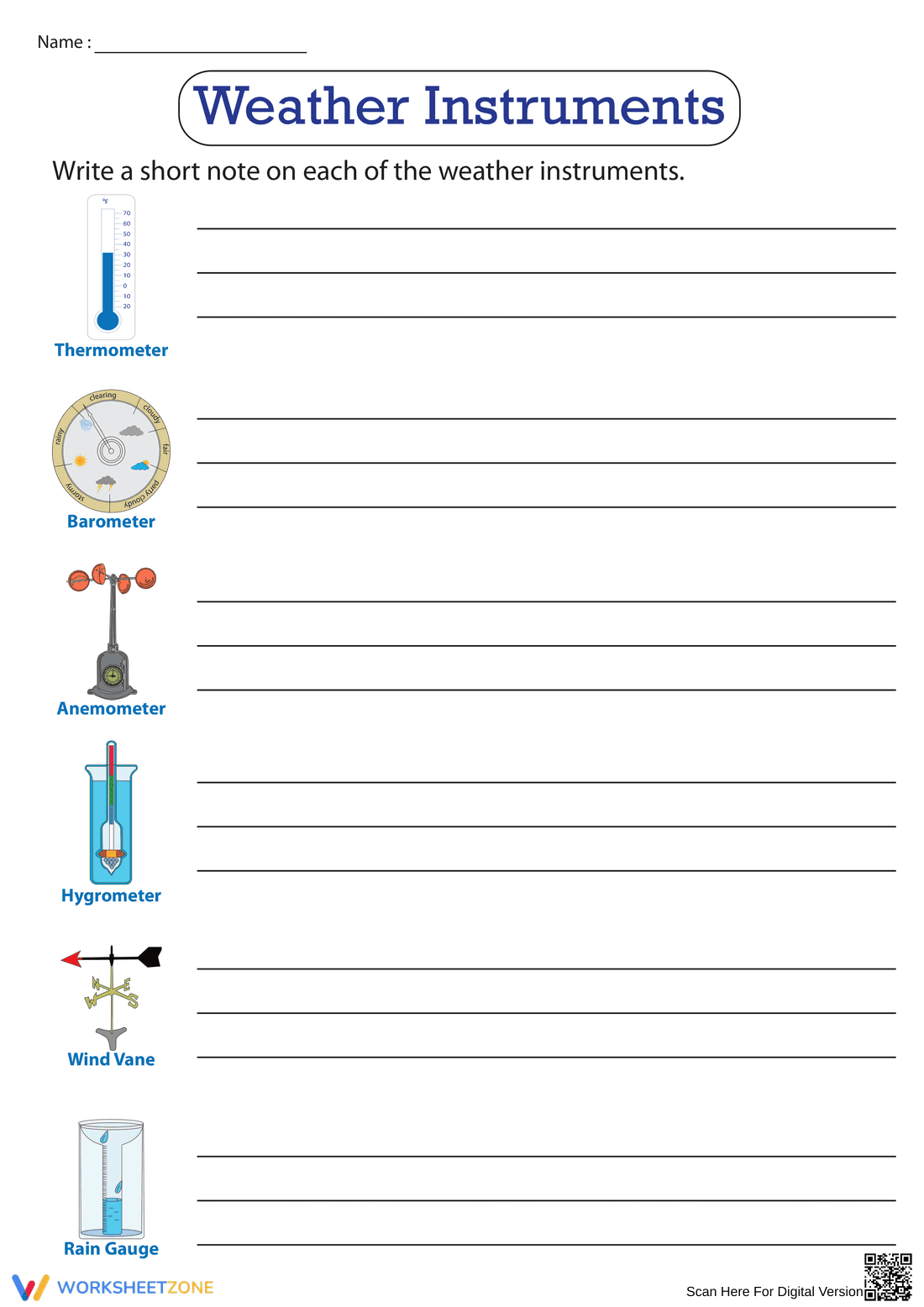
This worksheet helps students master the identification and function of common meteorological tools. Students will observe detailed illustrations of six essential instruments and write descriptive notes detailing their specific uses in measuring atmospheric conditions. It provides a clear, structured way to bridge the gap between observing weather and understanding the scientific technology used to track it.
At a Glance
- Grade: 2–3 · Subject: Science
- Standard:
3-ESS2-1— Represent data to describe typical weather conditions expected during a particular season- Skill Focus: Weather instrument identification
- Format: 2 pages · 6 problems · Answer key included · PDF
- Best For: Science centers or independent practice
- Time: 15–20 minutes
What's Inside
The PDF contains a comprehensive student worksheet featuring high-quality icons of a thermometer, barometer, anemometer, hygrometer, wind vane, and rain gauge. Each instrument is paired with dedicated writing lines, encouraging students to synthesize their knowledge into concise notes. A full-color answer key is provided, offering model descriptions that include historical context and precise scientific definitions for teacher review or student self-correction.
Zero-Prep Workflow
- Print: Generate the single-page student handout in under 1 minute.
- Distribute: Hand out sheets for independent work or as part of a weather unit rotation (30 seconds).
- Review: Use the included answer key for rapid grading or project it for a whole-class review (30 seconds).
This "print-and-go" design makes it an ideal choice for emergency sub plans or low-prep science blocks, requiring total teacher preparation time of less than two minutes.
Standards Alignment
The primary standard 3-ESS2-1 requires students to represent data in tables and graphical displays to describe typical weather conditions. This worksheet supports the foundational knowledge required for this standard by ensuring students can accurately identify and describe the tools used to collect that data. Both standard codes can be copied directly into lesson plans, IEP goals, or district curriculum mapping tools.
How to Use It
Use this worksheet as a summative assessment at the end of a weather unit to check for instrument mastery. During direct instruction, teachers can use it as a guided notes page, observing if students are correctly associating the anemometer with wind speed versus the wind vane with direction. Completion time is typically 15–20 minutes, making it a perfect transition activity or exit ticket following a hands-on lab with real weather sensors.
Who It's For
This resource is designed for Grade 2 and Grade 3 students beginning their formal study of Earth sciences. It is particularly effective for visual learners who benefit from the clear instrument graphics. It pairs naturally with a classroom weather station or a textbook passage on the history of meteorology, providing the necessary written reinforcement for technical vocabulary acquisition.
Research from EdReports 2024 emphasizes the importance of integrating scientific literacy with informational writing at the primary level. This Grade 2-3 worksheet aligns with these findings by requiring students to describe the functional utility of six essential weather instruments. By moving beyond simple matching to short-note composition, the resource reinforces the 3-ESS2-1 standard's focus on describing atmospheric conditions through empirical evidence. The inclusion of historical inventors in the answer key, such as Torricelli and Da Vinci, provides cross-curricular connections that enhance student engagement and retention of scientific concepts. This structured approach to vocabulary and function mastery ensures that young learners develop the technical foundations necessary for more complex climate analysis in later grades, as supported by the NAEP frameworks for elementary science education. The clear layout reduces cognitive load, allowing students to focus on the precision of their scientific descriptions and the application of weather-related terminology.


